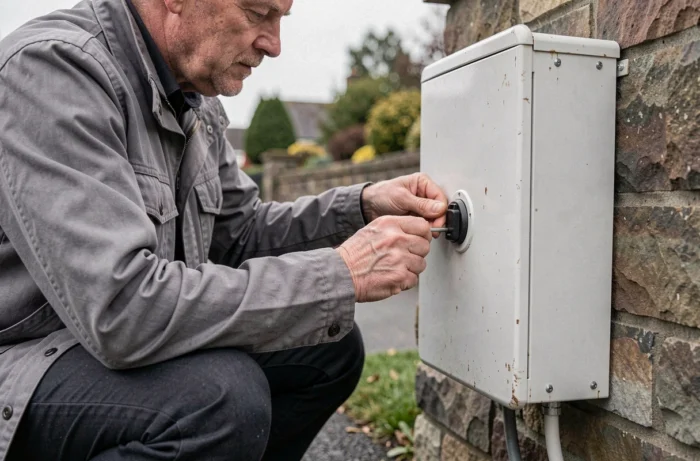
You return home one stormy evening, the street is plunged into darkness, and your Beninca gate refuses to budge. The motor is unresponsive, and the remote control remains silent. The priority is not to understand why the power has gone out, but to get through this gate to access your property.
Beninca Mechanical Release: Where to Find the Lock on Your Motor
On Beninca motors, the release system is integrated directly into the motor block. It can be identified by a key cylinder, sometimes protected by a plastic cover, located on the motor casing (for a sliding gate) or on the operator’s arm (for a swinging gate).
The release key is usually provided during installation. It resembles a small triangular key or a cylinder, depending on the model. If you have never used it, check the documentation pouch delivered with the motorization, or the storage hook that some installers attach near the motor.
The standard EN 13241 requires a manual release device on all recent motorized gates. This device must be operable by a non-specialist without any special tools other than the provided key. If your Beninca installation is compliant, the release must exist, even if you have never located it.
To find the procedure in case of a power failure suitable for your specific model, consult the reference noted on the motor’s label (Bull series, Bob, Rib, etc.).
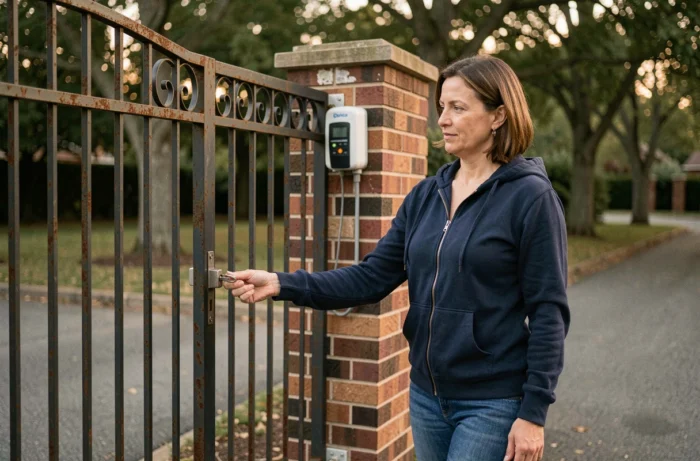
Sliding or Swinging Beninca Gate: The Handling Differs
You do not release a sliding gate motor like that of a swinging gate. Confusion is common and can damage the mechanism if you force it in the wrong place.
Beninca Sliding Gate
The motor is fixed to the ground next to the guide rail. Insert the key into the cylinder of the casing, turn (usually a quarter turn). You will feel a click: the rack disengages from the drive pinion. The leaf then slides freely on its rail, like a non-motorized gate.
Push the gate slowly. On heavy models, the leaf gains momentum and can be difficult to stop. Keep your hands on the edge, not in the gaps of the frame.
Beninca Swinging Gate
Each leaf has its own operator (cylinder or articulated arm). Therefore, you must release both motors separately. The cylinder is located on the body of the cylinder or at the base of the arm.
After unlocking, open each leaf manually by pushing it outward. Feedback varies on this point: some users find that Beninca cylinders offer slight resistance even when released, especially on older installations where the grease has dried.
Safety During Manual Operation of the Gate
Operating a gate without electrical power also disables the automatic safety devices: photocells, obstacle detection, force stop. This is a point often overlooked.
- Ensure that no one is in the path of the leaf or sliding gate before pushing, especially if children or pets are nearby.
- Never leave the gate in a semi-open position without securing it: a gust of wind or a slight slope is enough to set it in motion.
- Block the gate in the open position with a wedge, a heavy stone, or the holding device provided by the manufacturer, while you park your vehicle.
- If the gate is equipped with a manual lock in addition to the motor, lock it once the gate is closed to prevent any intrusion during the outage.
Restoring Beninca Motorized Mode After Power Returns
The power returns, but the gate remains inert. This is normal: the motor is still in the released position. This step is often forgotten, leading to unnecessary calls to the repairman.
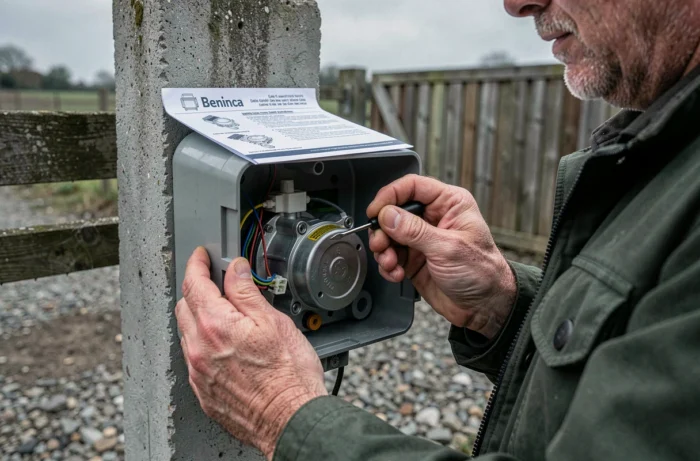
Relock the release cylinder with the key, in the opposite direction of opening. You should hear the same click as during unlocking. The pinion re-engages on the rack (sliding) or the cylinder reconnects to the arm (swinging).
Then test with the remote control. If the gate does not respond, the electronic board may have suffered a surge during the outage. Check the circuit breaker dedicated to the gate circuit on your electrical panel. The standard NF C 15-100 requires a dedicated circuit breaker for gate motorizations, which protects the control board in case of a sudden power return.
If the circuit breaker is properly engaged and the motor remains silent, disconnect the motor’s power for about thirty seconds, then reconnect. This reset often suffices to reset the Beninca board.
Prevention: Avoid Getting Stuck During the Next Outage
Some precautions significantly reduce the stress of a future breakdown.
- Store the release key in a location accessible from outside the property (a code box fixed to the wall, for example), not in the garage that the gate is supposed to protect.
- Test the release maneuver at least once a year. A cylinder that has never turned can seize up after several seasons of exposure to the elements.
- Consider adding a backup battery compatible with your Beninca motorization. Some models accept a battery kit that automatically takes over during an outage, providing several opening-closing cycles autonomously.
A well-maintained Beninca gate, with an accessible release key and a lubricated cylinder, can be operated in less than a minute in case of a power outage. The only real trap is discovering the existence of the backup system on the evening when you need it for the first time.