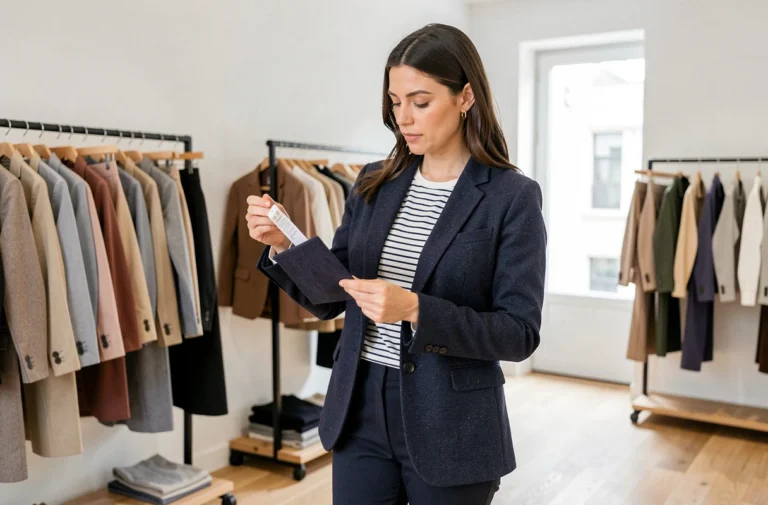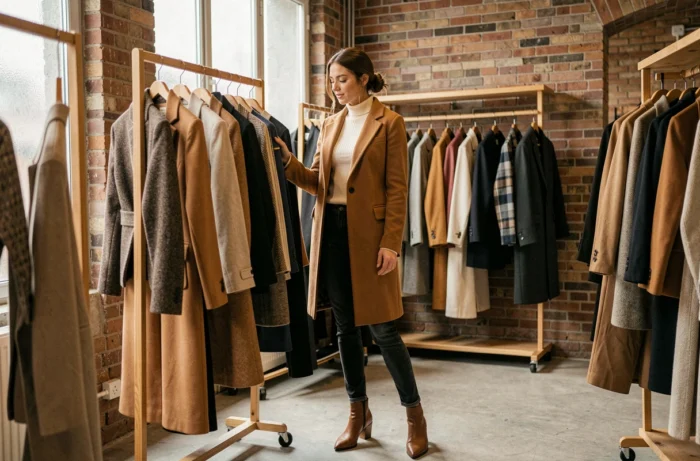
Finding a soft leather jacket that works just as well over barrel jeans as it does over a midi dress, without looking like a costume: this is the kind of concrete constraint that sums up the fashion trends of this season. The autumn-winter collections and the extensions of the spring-summer 2026 season share a common thread, that of pieces with high usability, easy to combine, and designed to last more than one season.
Leather, linen, and denim: the materials that dictate silhouettes this season
We start with the fabric, not the color. The choice of material determines the cut, drape, and lifespan of the garment. This season, three families of textiles are consistently returning to wardrobes.
Smooth leather and suede dominate jackets, blousons, and structured skirts. Soft leather replaces the stiff leather of previous seasons, allowing for more enveloping cuts that hug the body without sacrificing comfort. Suede, on the other hand, adds a matte texture that works equally well in short jackets and midi skirts.
Denim is not backing down. It is now available beyond the classic jean: we see it in shirt dresses, oversized jackets, and long skirts. The barrel cut (wide leg, high waist, tapered hem) remains the most worn jean silhouette because it elongates the leg without requiring heels.
To navigate among the leather, denim, or linen pieces offered by various brands, the entire DLG Fashion site allows for quick comparison of cuts and price ranges.
Linen and braided cotton extend their summer presence into back-to-school looks. They are paired with a heavier piece (a wool blazer, a military jacket in thick canvas) to create a contrast of textures that adds depth to a simple outfit.
Autumn-winter colors: beyond khaki and burgundy
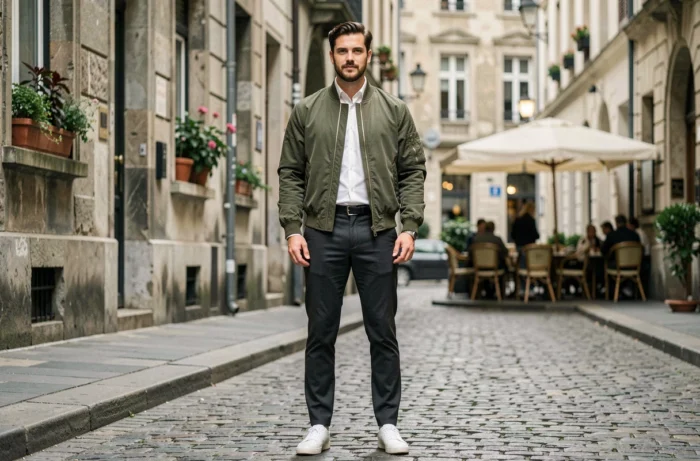
Khaki, olive green, and brown form the chromatic base of the premium military trend that marks the return to school. We see them on parkas, cargo pants, and boots with lug soles.
This sober trio is not enough to create a complete look. A point of contrast is needed. Red remains the standout color spotted on the spring-summer 2026 runways, and it extends into autumn in deeper shades (garnet red, brick red). One red piece is enough to structure a neutral outfit: a bag, a belt, or a pair of shoes.
Pastel shades (rosy beige, sky blue, water green) work in layers under a dark jacket. We avoid the total pastel look in autumn, which can appear washed out under gray natural light. The ground rule: one pastel piece maximum per outfit as brightness decreases.
Combining colors without overloading
- Neutral base (black, navy, gray, camel) on the lower body, strong color on the top or accessories
- No more than three color families per outfit, including accessories
- Off-white replaces pure white in autumn-winter, as it captures artificial light better and yellows less quickly in washing
Women’s fashion accessories: the pieces that truly change a look
Accessories are the quickest lever to update a wardrobe without buying everything new. However, it is essential to focus on those that have a real visual impact.
A bag made of natural materials (raffia, wicker, braided cotton) remains a safe bet, but it is now worn in a rigid and compact version rather than a soft tote. This structured format transitions from the office to the weekend seamlessly.
Detail-oriented shoes (visible buckles, contrasting stitching, cut-out designs) take over from minimalist models. Cut-out ballerinas, in particular, serve as an alternative to flat sandals in mid-season. They add character without the bulk of a boot.
The lightweight scarf returns as a multifunctional accessory: tied to a bag, worn as a headband, or tucked under a jacket collar. Opt for a silk or modal scarf rather than polyester, as the knot’s hold and drape are incomparable.
Second-hand and regulations: what’s changing for buying fashion in 2026
We can no longer talk about trends without mentioning the framework in which we buy. France is now legally regulating so-called “ultra-express” fashion, with progressive restrictions on the advertising of certain ultra-fast-fashion brands since July 2026. The implementing decrees are still partially pending, but the direction is clear: brands with very rapid turnover will see their advertising visibility reduced.
On the second-hand side, a report from Oxfam France published in September 2026 highlights that the environmental impact varies depending on the purchasing channel. Buying on an online platform with long-distance shipping does not have the same impact as purchasing from a local second-hand physical store. Returns on this point vary according to studies, but the distinction is worth noting when building one’s wardrobe.
High resale value pieces
The online fashion market is evolving towards a hybrid model where resale is becoming increasingly significant, according to Fevad. This change concretely favors certain types of pieces:
- Durable accessories (leather belts, structured bags) resell better than seasonal clothing
- Pieces that are easy to authenticate (visible brand, readable inner label) find buyers faster
- Noble materials (leather, wool, silk) retain their value, unlike synthetics which depreciate significantly
Building a style this season also means anticipating what each piece will be worth in a year. A well-cut wool blazer or a smooth leather bag can be resold, while a trendy polyester top cannot. The choice of materials aligns with the stylistic choice, and this is likely the true guiding principle of this fashion season.