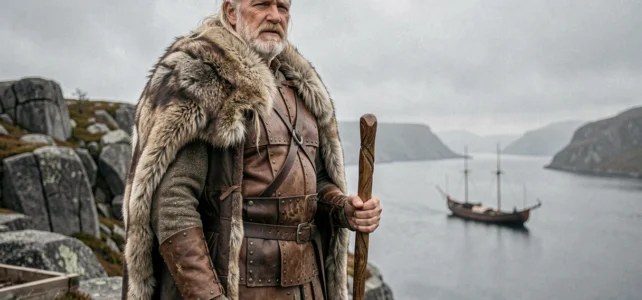
Ivar the Boneless is one of those Viking figures whose name circulates widely, but whose historical reality remains surprisingly vague. Presumed son of Ragnar Lodbrok, military leader of the Great Pagan Army that swept through England in the 9th century, he embodies several layers of narrative: hostile Anglo-Saxon chronicles, late Icelandic sagas, and contemporary television adaptations. Untangling the historical figure from the literary character requires examining what the sources actually say.
The nickname “Boneless”: a riddle that historians have not solved
Ivar’s nickname, in Old Norse inn beinlausi, is one of the most debated elements of his biography. Several hypotheses have coexisted for over a century without any one prevailing. Some see it as evidence of a real physical disability (bone disease, inability to walk), while others interpret it as a metaphor related to his flexibility in combat or tactical agility.
More recent interpretations suggest a sexual allusion (impotence) or a play on words related to wind, referring to his navigational skills. The nickname remains fundamentally unexplained for historians, and the later sagas, written several centuries after the events, only add narrative layers without providing a definitive key.
The saga of Ragnar Lodbrok links the nickname to a curse: Ragnar and Aslaug allegedly ignored a ritual prohibition on their wedding night, condemning their son to be born with cartilage instead of bones. This tale falls within the realm of Scandinavian folklore motifs, not medical testimony. To delve deeper into the true story of Ivar the Boneless, one must accept that the boundary between fact and legend remains porous on this specific point.
Great Pagan Army: Ivar the military strategist in England
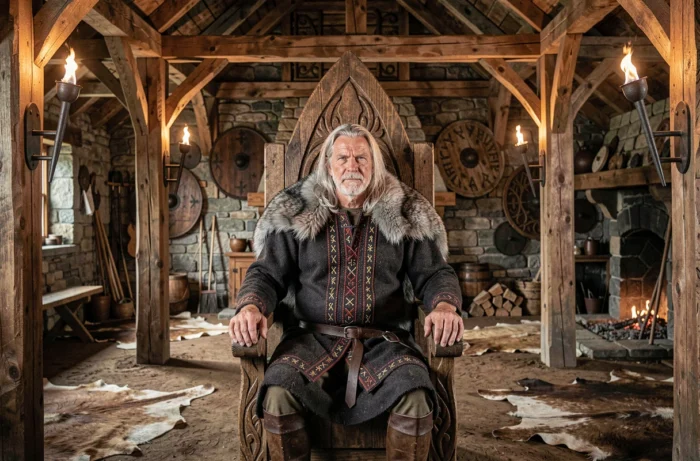
What anchors Ivar in documented history is his role at the head of the Great Pagan Army (micel heathen here in the Anglo-Saxon chronicles). This invading force, which landed in East Anglia in 865, likely represented the most significant military expedition seen in Britain since the arrival of the Anglo-Saxons.
Ivar did not lead this army alone. His brothers Halfdan and Ubba are mentioned as co-commanders. The chronicles attribute a tactical leadership role to Ivar, but the exact distribution of power among the brothers remains uncertain. The Anglo-Saxon sources, written by Christian monks suffering from the raids, had obvious reasons to personalize the threat around a single, terrifying figure.
The army conquered the kingdom of Northumbria, captured York, and then turned towards Mercia and East Anglia. The death of King Edmund of East Anglia, attributed to the Vikings, fueled a martyr cult that further amplified Ivar’s reputation for cruelty in later texts.
Revenge against King Ælla: fact or narrative construction
The most famous episode remains the supposed execution of King Ælla of Northumbria by the blood eagle torture. According to the sagas, Ivar avenged the death of his father Ragnar, thrown into a pit of snakes by Ælla, by inflicting this ritual that involved opening the victim’s back and extracting the lungs.
No contemporary source of the events mentions this torture. It appears in Norse texts written much later. Several medievalists believe that the blood eagle could be a misreading of poetic imagery, a metaphor from skaldic poetry interpreted literally by later compilers. The available data does not allow us to conclude whether this ritual ever existed as a real practice.
Excavations at Repton: archaeology facing the legend of Ivar
The site of Repton, in Derbyshire, represents the most tangible point of contact between Ivar and archaeology. Excavations there uncovered a mass grave containing hundreds of bodies, associated with the camp of the Great Pagan Army.
Initial radiocarbon dating had caused confusion by spreading dates over several centuries, challenging the link to a unique episode. A dating campaign conducted in 2018 corrected this issue: the high consumption of seafood by the Vikings skewed the initial results.
Once this marine reservoir effect was accounted for, the bodies were redated to the late 9th century, confirming that this was indeed a singular event related to the army’s passage. This technical correction strengthens the concrete link between his military command and an archaeologically documented site, without allowing for the identification of his body among the remains found.
Anglo-Saxon chronicles and source bias regarding the Vikings
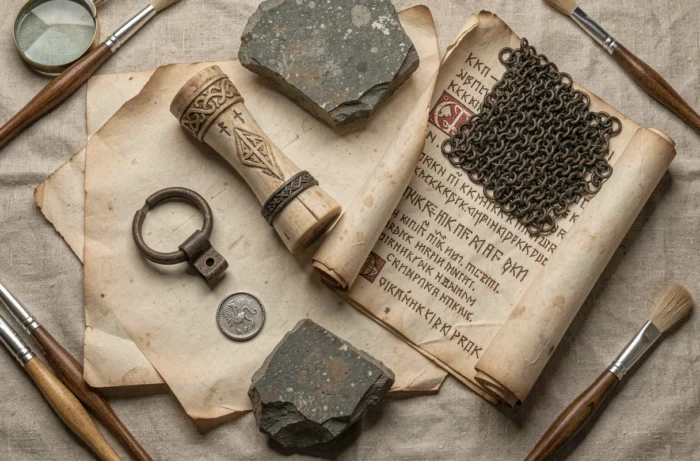
The designation of Ivar as a “bloodthirsty tyrant” is increasingly presented by historians as a direct legacy of the Anglo-Saxon chroniclers. These texts use terms like “viking tyrant” to describe his expeditions, a vocabulary that is anything but neutral.
Recent English-language popular works emphasize a structural point:
- The primary sources on Ivar are texts from the vanquished, written by religious figures whose monasteries had been pillaged by the Great Army
- The Scandinavian sagas, favorable to Ivar, were compiled several centuries after the events and mix historical elements with mythological motifs
- No text produced by Ivar’s own camp has survived, making any biographical reconstruction dependent on biased sources in one direction or another
The portrait of Ivar thus oscillates between two opposing narrative constructions. On one side, the monster of the Christian chronicles. On the other, the hero of the Nordic sagas. Neither constitutes a reliable testimony in the modern sense of the term.
Ragnar Lodbrok himself: perhaps a fictional father
The question of source bias extends to Ivar’s lineage. Ragnar Lodbrok, his presumed father, may be a composite character, a blend of several historical Viking leaders. If the father is partly legendary, Ivar’s genealogy rests on unstable foundations, further complicating the distinction between the real war chief and the saga character.
Ivar’s own death remains poorly dated. Sources place it between 870 and 878, without specifying the circumstances. This decade-long imprecision illustrates how much the historical figure eludes behind the literary character. Hero or tyrant, the answer depends less on Ivar than on those who wrote about him, and the reasons why they did so.