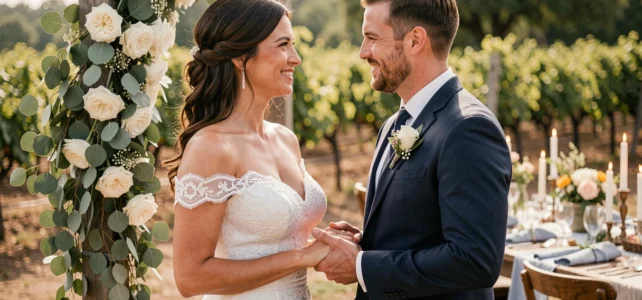
Organizing a personalized wedding often starts with a simple intuition: this day should reflect the couple, not a catalog of service providers. The challenge is to transform this desire into concrete choices, from the format of the reception to the rituals of the ceremony. Here’s how to lay the groundwork for an unforgettable wedding without replicating a standard model.
Immersive micro-wedding: fewer guests, more personalization
The most striking trend in wedding planning for 2026 is the intentional reduction of the guest list. We move from a large reception to a more intimate format, often between 30 and 60 close friends and family, gathered over several days in a unique location.
Why this choice? Because a smaller number of guests allows for the personalization of every detail. Instead of managing the logistics of hundreds of attendees, the couple invests in the individual experience: charming accommodations, tailored gastronomy, shared activities.
A private estate, a Provençal farmhouse, or a family castle then becomes the setting for a complete stay. Guests do not simply come to attend a ceremony. They experience a collective moment over two or three days, with free time, extended meals, and organized walks. To explore providers and venues suitable for this type of celebration, platforms like lemondedumariage.fr gather professionals specialized in every aspect of preparation.
Reducing the number of guests is not a compromise, it’s a design choice. The budget per person increases, as does the quality of each interaction. Testimonials from couples who have chosen this format all highlight the same point: guests remember every moment because they were participants, not spectators.
Personalized wedding ceremony: creating your own rituals
The secular ceremony opens a space of freedom that many couples underutilize. Instead of reproducing a classic format with texts found online, it is possible to create rituals that tell a specific story.
Three rituals that work beyond the symbolic
Have you ever attended a ceremony where the ritual seemed tacked on, with no connection to the couple? This often happens when a gesture is chosen for its aesthetics (sand ceremony, candle ritual) without giving it personal meaning.
- The simultaneous writing ritual: each partner writes a sentence live that the other reads aloud. No preparation, no memorized speeches, just a spontaneous reaction in front of loved ones.
- The active witness ritual: instead of a single speech at the end of the meal, each witness shares a short anecdote (maximum two minutes) during the ceremony that highlights a trait of the couple.
- The sensory ritual linked to the location: if the wedding takes place in a vineyard, a blending of wines by the couple. In a garden, a joint planting. The gesture is rooted in the place, not interchangeable.
A successful ritual evokes emotion because it is specific. If you can transpose it exactly to any other couple, it lacks personalization.
Wedding ambiance and decoration: the theme as a subtle guiding thread
The classic pitfall of a wedding theme is excessive visual coherence. Everything matches, everything is coordinated, and the result resembles a showcase.
A good theme works like a background color, not like a costume. It guides choices without dictating them. For example, a “travel” theme does not mean having globes on every table. It can translate into a menu inspired by cuisines discovered together, table names corresponding to visited cities, and a playlist that mixes the musical influences of those destinations.
Decoration: three areas to prioritize investment
Rather than spreading the decoration budget evenly, focus resources on the elements that guests see the longest:
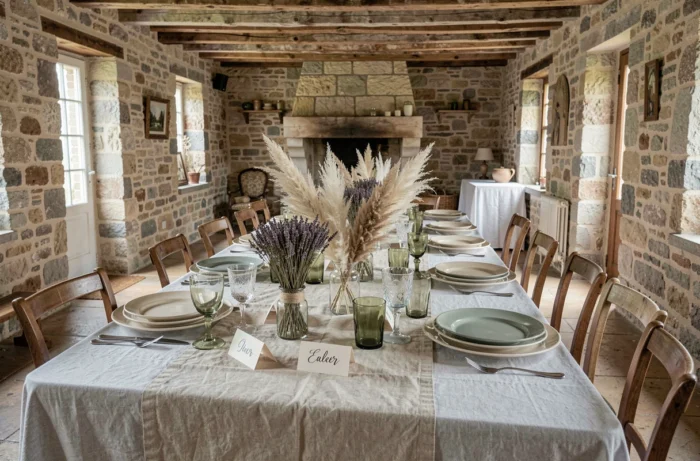
- The reception table, where guests spend several hours. Tableware, table linens, low floral arrangements that allow for conversation.
- Evening lighting: string lights, candles, lanterns. Light transforms an ordinary space into a memorable one, more than any decorative item placed on a shelf.
- The welcome area, the first visual contact for guests with the reception venue. A floral arch, a calligraphed sign, a welcome bar with a signature drink are enough to set the ambiance.
Personalized dress code for guests: a trend that structures the aesthetic
For the past two years, couples wanting an original wedding have embraced a often overlooked lever: the dress code for guests. The idea is not to impose a uniform but to suggest a color palette or style of clothing that contributes to the visual harmony of the day.
A well-formulated dress code avoids mismatched outfits in group photos. It’s not about controlling, but guiding. A mention on the invitation (“ochre and terracotta tones,” “linen and light colors”) is enough to create coherence without stifling individual freedom.
This approach works particularly well for outdoor weddings, where natural light enhances a limited palette. Wedding photographers confirm that photos improve in quality when the colors of outfits do not clash with the decor.
Hybrid invitation: combining paper and digital for a modern wedding
The invitation remains the first contact for guests with your wedding. In 2026, the hybrid format is gaining ground: a carefully crafted paper card for the announcement, accompanied by a link to a wedding website that centralizes practical information.
Paper retains its emotional value. We display it on a refrigerator, we keep it in a memory box. Digital takes over for everything that evolves: access plan, nearby accommodations, gift list, RSVP confirmation.
The hybrid invitation reduces logistical back-and-forth while preserving the elegance of a physical medium. Some couples add a discreet QR code on the back of the card, linking to their personalized website.
Organizing an unforgettable wedding does not rely on an unlimited budget or an accumulation of original ideas. It is based on deliberate choices, a coherent guiding thread, and details that speak of the couple. Every decision, from the number of guests to the ceremony ritual, builds an experience that loved ones will permanently associate with that specific day.