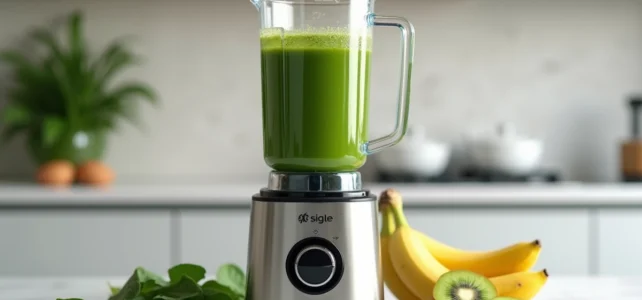
The show Top Chef features equipment designed for performance in a professional environment. The blenders used on set meet robustness and speed requirements that have little to do with preparing a Sunday soup. Starting from this observation allows for a better understanding of what a “Top Chef” branded blender can actually bring to a home kitchen, and where its limits lie.
Professional blender vs. domestic blender: what the show doesn’t show
The kitchens of Top Chef are historically equipped by professional French brands like Cristel for cooking utensils. This professional equipment logic is also reflected in the choice of blenders: the devices favored on set are designed to run for several hours a day, withstand very hard textures, and maintain consistent results across hundreds of preparations.
A professional blender operates with an oversized motor, hardened steel blades, and a ventilation system suited for intensive use. These characteristics pose a concrete problem in a home kitchen: the domestic electrical installation and ventilation are not always compatible with this type of device. Safety standards differ between a professional environment and an individual residence, particularly regarding electrical power and heat dissipation.
Before asking which Top Chef blender to choose, it is essential to distinguish between the device actually used in competition and a consumer model marketed under license. The two categories often share only the name.
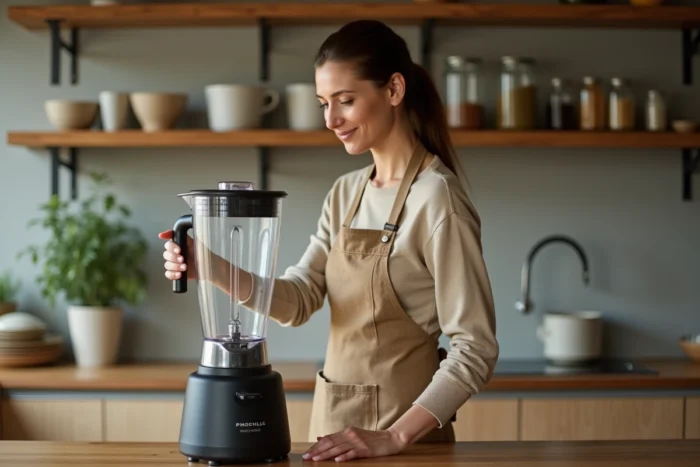
Motor power and blade quality: the two criteria that change everything
The power of a blender is measured in watts, but this number alone doesn’t tell the whole story. A powerful motor paired with poorly designed blades will yield mediocre results. Conversely, well-shaped blades can partially compensate for a modest motor in soft preparations like smoothies or compotes.
To blend hard foods (ice cubes, nuts, fibrous raw vegetables), the motor/blade combination becomes crucial. Serrated stainless steel blades, mounted on a thick shaft, resist wear better than the thin blades often found on entry-level models.
How power affects recipes
- Soups and veloutés require prolonged rotation at medium speed. A motor that heats up quickly at this pace produces inconsistent results and can damage the bowl.
- Thick smoothies, with frozen fruits or seeds, demand brief but intense power spikes. The motor’s torque (its ability to maintain speed under load) matters more than the nominal power displayed.
- Crushed ice and frozen preparations put the blades to the test. In this type of task, the difference between a mid-range device and a well-designed appliance is immediately felt in the texture achieved.
A high-performing blender for daily cooking doesn’t need to be the most powerful on the market, but it must offer a good balance between motor torque, steel quality of the blades, and speed regulation.
Glass bowl or plastic bowl: a choice less trivial than it seems
The material of the bowl influences durability, weight, cleaning, and even the taste of the preparations. Borosilicate glass withstands thermal shocks and does not retain odors, making it a suitable choice for hot soups and spice blends.
Plastic (often Tritan) is lighter and nearly unbreakable. It is better suited for families with children or those who transport their blender. However, plastic scratches over time, and these micro-scratches become breeding grounds for bacteria that are difficult to clean.
Bowl capacity and number of servings
The usable capacity of a bowl is always less than its total advertised capacity. A bowl rated at 1.5 liters only comfortably allows for blending about one liter of soup without risking overflow. For a family, a large-capacity bowl prevents multiple rounds. For solo use (a smoothie in the morning), a compact bowl is sufficient and takes up less space on the countertop.
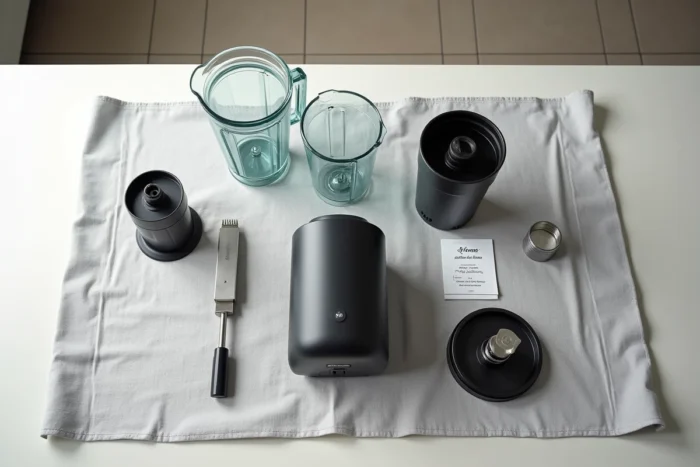
Cleaning and maintenance of the blender: the criterion that no one checks in-store
Cleaning determines the actual frequency of use of a blender. A device that is difficult to disassemble ends up at the back of the cupboard. Models with blades that detach from the bowl are easier to clean, but this design increases the risk of leaks at the seal if it wears out.
Automatic cleaning programs (filling the bowl with warm water and a drop of dish soap, running a short cycle) exist on some models and reduce the chore. This detail, rarely mentioned on product sheets, makes a real difference in daily use.
- Check that the blade assembly can be disassembled without tools for thorough cleaning.
- Prefer a dishwasher-safe bowl if manual cleaning is a deterrent.
- Inspect the condition of the sealing ring every few months to avoid leaks and contamination.
A well-maintained blender retains its performance for years. The real cost of a blender includes the replacement of seals and blades, not just the initial purchase price. Some manufacturers offer accessible spare parts, while others do not, making the device disposable at the first wear.
Choosing a blender to replicate recipes seen on Top Chef is less about seeking maximum power than identifying the device whose motor, blades, bowl, and ease of maintenance match what you actually cook. A device suited to your habits, used three times a week, produces better results than a high-end model that remains in its box.