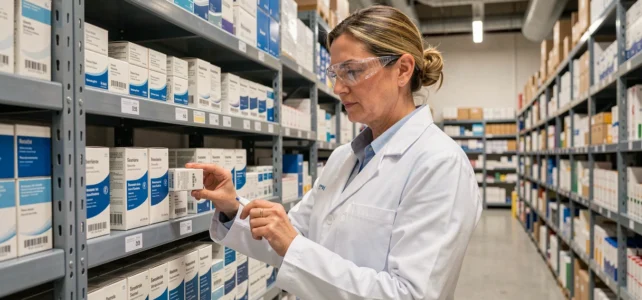
A chemotherapy carton arriving twenty minutes late in an oncology department means a delayed protocol and a bed occupied longer than expected. The management of pharmaceutical flows hinges on this level of detail: every disruption, every temperature deviation, or every routing error has direct consequences on care.
Logistical responses are evolving rapidly, driven by technologies that are significantly changing the daily operations of hospital pharmacy teams and distribution warehouses.
Hospital delivery robots: what AMRs change in internal flows
We often talk about stock optimization or management of in-house pharmacy. However, the weak link remains the physical transport between the central pharmacy and the care units. In many establishments, agents are still pushing carts through the corridors, sometimes across multiple floors.
Autonomous mobile robots (AMRs) are beginning to replace these manual circuits. One documented case shows that a robot assigned to the flow between the oncology pharmacy and the administration room has allowed for gaining 5 to 10 minutes per patient, with 75 to 80 trips per day and about 30,000 deliveries over 18 months. These are not commercial projections: they are operational data measured on-site.
Platforms that centralize these solutions, such as pharmalog.fr, enable establishments to compare offers and identify providers suited to their configuration. The challenge is not to robotize for the sake of robotization, but to free up caregiver time from low-value tasks.
Pneumatic systems, still present in some older buildings, do not manage the volumes or the diversity of formats that mobile robots handle (infusion bags, sterile devices, laboratory samples).

Automated pharmaceutical picking: the goods-to-person model applied to medication
In distribution warehouses, order preparation remains the most labor-intensive task. The goods-to-person model, where the product comes to the preparer rather than the other way around, has become established in e-commerce. It is now entering pharmaceutical logistics with additional constraints: unit traceability, expiration date management, Datamatrix serialization.
Fleets of AMRs dedicated to medication picking are being deployed across multiple sites in Europe. The principle: robots navigate between shelves, retrieve bins containing the requested references, and transport them to a consolidation station.
What changes concretely for operators:
- The daily walking distance is significantly reduced, which decreases physical fatigue and picking errors related to inattention
- The stock turnover rate accelerates thanks to software management that prioritizes batches close to their expiration date
- Serialization is integrated into the flow, with each unit being scanned at the time of picking without additional manual steps
Returns vary regarding the return on investment timeframe depending on the site size and volume processed, but the trend is clear: goods-to-person robotization is becoming a structural component of the pharmaceutical supply chain, not just a simple innovation gadget.
Cold chain and real-time traceability: regulatory constraints and field tools
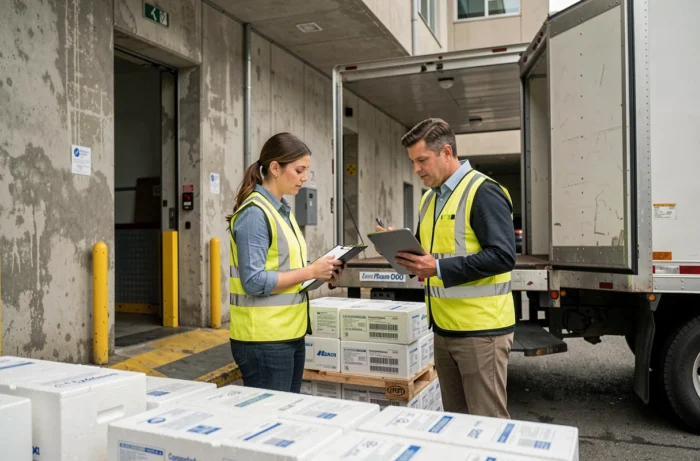
A temperature-sensitive medication that goes outside its temperature range during transport is a lost medication, sometimes an entire batch. Good Distribution Practices (GDP) require continuous temperature monitoring, but the methods of ensuring this vary greatly from one provider to another.
IoT sensors embedded in insulated containers now transmit their data in real-time to supervision platforms. The alert no longer triggers afterward, but during transport, allowing for an intervention window (rerouting, activation of a cold plan). For the flows of biological products or gene therapies, this responsiveness is not a comfort; it is an obligation.
At the same time, the European serialization directive mandates that each box of medication be individually identifiable. Warehouses handling multi-reference packaging must manage serialization not only at the box level but also at the aggregated package level. Recent WMS (Warehouse Management Systems) natively integrate this layer, but older installations often require added serialization middleware, with the frictions that this entails.
Multi-site pharmaceutical flows: coordinating without centralizing
The classic temptation is to centralize everything in a single warehouse to reduce storage costs. In pharma, this approach faces two realities: delivery times imposed by wholesalers (often within 24 hours) and the diversity of order formats depending on the channels (pharmacy, hospital, direct patient sales).
The logistical architectures that work today rely on a network of interconnected regional platforms supported by a common information system. Each site manages its local stock, but restocking and inter-site transfers are driven by demand forecasting algorithms.
- Regional platforms reduce the last mile and secure regulatory deadlines
- Centralized data management prevents overstocking at one site while another is under pressure
- AMRs can be deployed gradually, site by site, without a complete overhaul of the infrastructure
Coordinating data without centralizing physical stocks remains the most operational compromise for pharmaceutical distribution networks in Europe. Technology allows it, provided that the information systems of the different sites genuinely communicate with each other, which remains the main friction point on the ground.
The pharmaceutical sector does not have the luxury of logistical approximation. Every minute saved on an internal hospital flow, every picking error avoided, every temperature deviation detected in real-time translates directly into care quality. The tools exist. The difficulty, as seen site by site, remains integrating them into often heterogeneous infrastructures and organizations accustomed to operating differently.