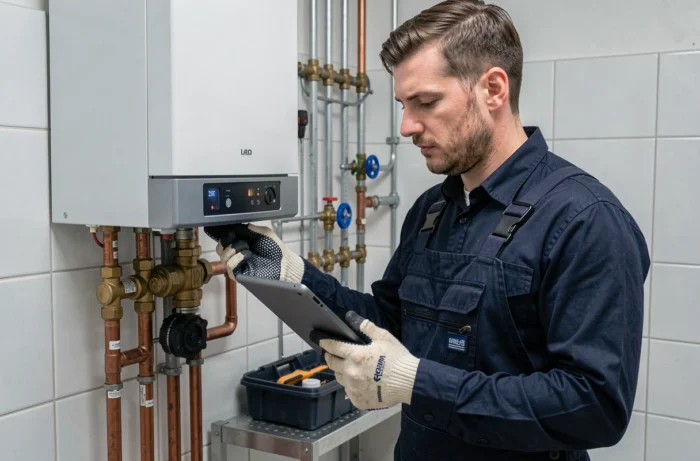
A poorly configured or neglected central heating system can degrade its efficiency by several points in just one season. In Brussels, where energy performance regulations are tightening, optimizing the maintenance of your heating system is no longer just a matter of comfort; it is a regulatory requirement with specific deadlines.
Hydraulic pressure and sludge: parameters not covered by periodic checks
The mandatory periodic inspection in the Brussels Region focuses on combustion, emissions, and boiler safety. What this inspection does not check is the condition of the downstream hydraulic circuit: expansion tank pressure, water quality, presence of sludge in the radiators.
We regularly observe installations where the boiler passes the inspection without any remarks, but where the distribution circuit loses several degrees between the supply and return due to advanced sludge buildup. Chemical or hydrodynamic desludging is not included in standard maintenance. It must be explicitly requested.
The service pressure should remain stable between 1.2 and 1.8 bar when cold on most residential installations. A regular drop indicates either a leak or an expansion tank with a ruptured membrane. Replacing a faulty tank is inexpensive and prevents constant strain on the circulator.
Adopting the best practices for heating in Brussels involves considering the entire circuit, not just the burner.
PEB obligations in Brussels: consumption thresholds and sanction timeline
Standard articles on heating maintenance rarely address the Brussels energy performance framework. Since 2026, the Region has made energy performance thresholds legally binding, directly targeting heating consumption.
The timeline is precise: maximum primary energy consumption of 275 kWh/m²/year by 2033, then 150 kWh/m²/year by 2045. Specific fines are planned starting in 2033 for non-compliance, calculated based on the deviation from the threshold and the size of the dwelling.
In practical terms, a dwelling rated F or G on the energy performance certificate will not be able to meet these thresholds solely by replacing its boiler. We recommend a combined approach:
- Prioritize reducing heat demand (insulation of walls, replacing glazing), as no high-efficiency boiler can compensate for a failing thermal envelope.
- Adjust the water supply temperature based on the actual insulation of the building, aiming for low-temperature operation if the emitters allow it.
- Plan the replacement of the gas or oil boiler considering the gradual ban on new fossil installations in new buildings in Brussels, which signals a tightening for existing ones.
Optimized maintenance of the heating system thus fits into a broader strategy for PEB compliance.
Adjusting the heating curve: the most underutilized free lever
The heating curve determines the temperature of the water sent into the circuit based on the outside temperature. On most wall-mounted boilers installed in Brussels, the heating curve is left at factory settings, calibrated for extreme conditions that do not correspond to the building.
The result: the boiler sends water at 70-75 °C when 50 °C would suffice. The overconsumption is direct, and the wear of the heat exchanger accelerates due to short on-off cycles.
How to adjust the heating curve without an external sensor
If the installation does not have an external sensor, we recommend manually lowering the supply temperature in increments of 3 to 5 °C, observing comfort over two to three days. The goal is to find the lowest point where the set temperature is reached without the boiler cycling constantly.
On condensing boilers (gas), the adapted efficiency is achieved when the return temperature remains below 55 °C, allowing for effective condensation of the flue gases. Above this, the boiler operates like a conventional boiler, and the extra cost at purchase has been wasted.
Gas and oil boiler maintenance in Brussels: frequency and key points
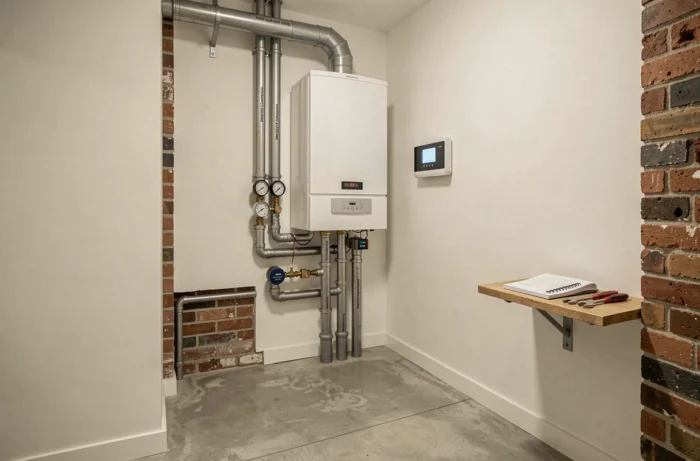
In the Brussels Region, periodic inspection of a gas boiler is mandatory every two years. For oil, the frequency is annual. These intervals are legal minimums, not comfort recommendations.
Between inspections, several operations can extend the life of the installation and maintain its efficiency:
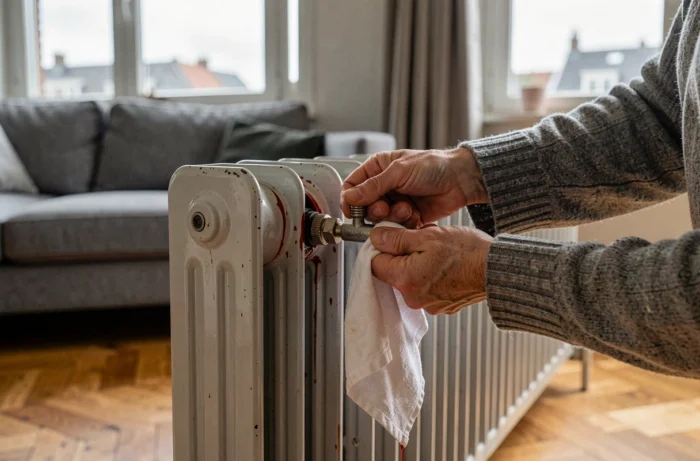
- Bleed the radiators at the beginning of the heating season to remove accumulated air, which reduces the heat exchange surface and generates circulation noises.
- Check the operation of the thermostatic valves by fully opening and closing them, as a valve stuck in an intermediate position skews the entire zone regulation.
- Visually inspect the flue gas discharge duct (for atmospheric boilers still in service) and clean the condensate trap on condensing boilers.
- Check the circuit pressure and compare it to the previous reading to detect any drift.
A well-maintained maintenance log facilitates the technician’s diagnosis and serves as an argument during the sale or rental of the property, especially in the context of PEB obligations.
Heat pumps and hybrid systems: different maintenance
The rise of heat pumps (HP) in Brussels is changing maintenance habits. An air-water HP does not require combustion checks, but its air filter, outdoor exchanger, and refrigerant level must be monitored.
For hybrid systems (HP coupled with a backup gas boiler), the switching logic between the two generators must be checked each season. A poorly calibrated switching threshold can cause the gas boiler to run when the HP would cover the demand, negating the benefit of the installation.
The regulatory framework in Brussels regarding HP maintenance is still being structured. We recommend an annual check by a certified technician, even in the absence of formal obligation, to preserve the manufacturer’s warranty and anticipate future requirements.
Optimizing the maintenance of a heating system in Brussels relies less on the frequency of interventions than on their technical relevance. Hydraulic circuit, heating curve, PEB compliance: every neglected parameter translates into additional consumption and, ultimately, fines.