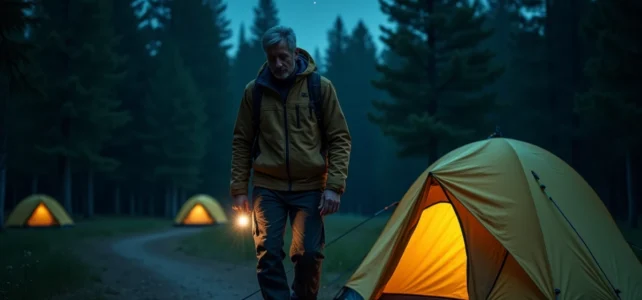
Managing a pressing need in the middle of the night while camping presents a real problem that every camper has encountered. Between the distance to the restrooms, the darkness, the cold, and the risk of waking up tent neighbors, there are many factors to consider. This article compares the available solutions, their constraints, and their relevance depending on the type of stay, whether in a developed campsite or in a bivouac.
Nocturnal Solutions in Camping: Comparative Table of Equipment
Several devices allow for addressing a pressing need at night without leaving the tent or by limiting movement. The choice depends on the context (camping with restrooms, bivouac in nature, family tent with children) and practical criteria such as weight, bulk, and discretion.
| Solution | Weight / Bulk | Suitable for Bivouac | Discretion in Tent | Hygiene |
|---|---|---|---|---|
| Moving to the restrooms | None | No (no restrooms) | Low (noise, zipper) | Good |
| Bottle or wide-opening container | Very light | Yes | Good | Average (risk of spillage) |
| Portable folding urinal | Light (less than 200 g) | Yes | Good | Fair (variable sealing) |
| Stand-up device (for women) | Very light | Yes | Good | Fair |
| Camping bucket or portable toilet | Bulky | No (difficult to transport) | Average | Good with absorbent bag |
| Absorbent protection for adults | Very light | Yes | Excellent | Good (single use) |
This table highlights a clear gap between solutions suitable for developed camping and those that actually work in bivouac or isolated tents. Moving to the restrooms, often presented as the norm, is in practice the least discreet and most disruptive solution for sleep.
Several of these tips for managing nighttime needs while camping should be anticipated before departure, as improvising on-site in the dark remains the worst option.
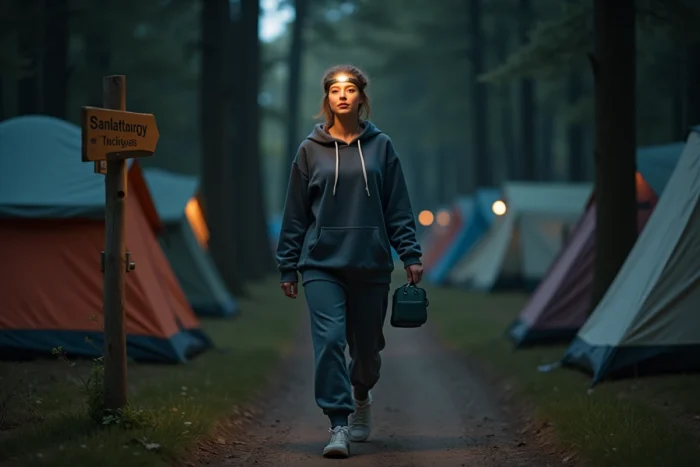
Stand-up Devices and Absorbent Protections: Game-Changing Equipment for Women in Bivouac
Stand-up devices for women are no longer a niche gadget. They are now recommended for urinating while standing, out of sight, without fully undressing. In bivouac or at a campsite far from restrooms, this is a direct advantage for cold or rainy nights.
The operation is simple: a soft silicone funnel directs the flow, allowing the use of a container or discreet relief outside the tent without squatting. Cleaning is done with clear water.
Another solution that was long considered taboo and is now accepted: absorbent protections for adults for occasional use. General media report that some festival-goers wear them during extended nighttime outings when access to restrooms is impossible. The same reasoning applies to camping, especially with children who cannot move alone at night.
This gradual normalization changes the perception. It is no longer a medical resort but a pragmatic choice, just like a waterproof sleeping bag or a headlamp.
Reducing Nighttime Awakenings: What Happens Before Bedtime
The frequency of pressing needs during the night largely depends on what happens in the hours leading up to it. Three levers directly affect the number of awakenings.
- Limit diuretic drinks after dinner: coffee, tea, beer, and alcohol in general increase urine production. Cutting these intakes two hours before bedtime significantly reduces nighttime bladder pressure.
- Emptying the bladder just before going to bed, even without a strong urge, to start with a nearly empty tank.
- Avoiding very salty meals in the evening: an excess of salt pushes the body to eliminate more water during the night.
These precautions do not eliminate awakenings, but they decrease their frequency. Going from two awakenings to one radically changes the quality of sleep over several nights in a tent.
The Particular Case of Cold
In high-altitude bivouac or during cool nights at the beginning and end of the season, the cold accelerates the urge to urinate. The body reduces blood circulation to the extremities and concentrates blood volume in the center, which increases kidney filtration. The result: the bladder fills faster.
A sleeping bag suitable for the temperature and proper insulation under the tent (mattress with a good R-value) reduce this effect. Sleeping warm mechanically decreases nighttime urges.
Camping with Children at Night: Anticipate Rather Than React
Children present a specific problem. They often wake up too late, cannot move alone in the dark to the restrooms, and an accident in a sleeping bag compromises the rest of the stay.
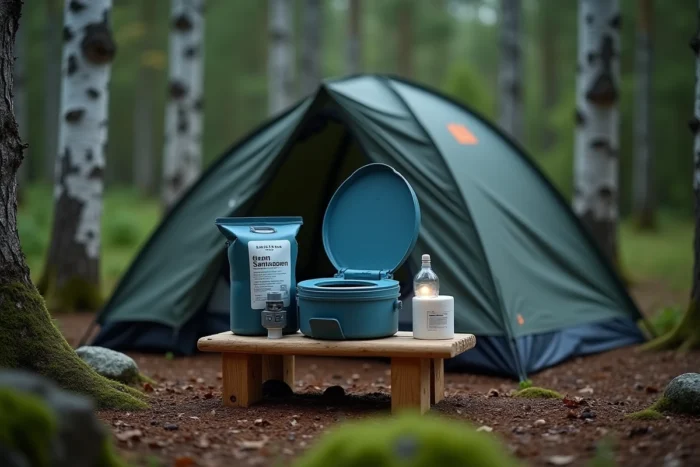
A portable potty placed under the tent’s awning solves most situations. Foldable models with disposable absorbent bags exist in compact versions and weigh little. For younger children, a nighttime diaper remains the most reliable solution, especially during the first nights when excitement and the change of environment disrupt habits.
Preparing an accessible nighttime kit (headlamp in red mode, wipes, potty or container) before closing the tent avoids rummaging in the dark that wakes up the whole family.
Bivouac in Nature: Regulations and Common Sense Hygiene
In bivouac, there are no restrooms or water points. Relieving oneself outside at night becomes the only option, but it involves rules. In national parks and certain nature reserves, urinating near a watercourse is prohibited. The minimum distance recommended by several park managers is several dozen meters.
On a bivouac site in the forest or at altitude, the reflex to adopt is to identify a relief point before nightfall, away from the campsite and water sources. This avoids tripping in the dark or contaminating a water collection area.
The choice between these different approaches depends on the type of stay, duration, and number of participants. A couple on a light bivouac does not have the same constraints as a family at a developed campsite. The common point remains the same: anticipate the night before it begins, and test your equipment before the first night in the tent.